
MDA: Mechanical Alignment

In the previous essay, I explained that games can be classified into 9 Aesthetics proposed by Marc LeBlanc, Robin Hunicke and Robert Zubek in their 2004 paper: The MDA Framework. But to keep things tight and orderly, I didn’t elaborate on how to build an Aesthetic for a game.

In this essay I’ll focus on that part with the help of two concepts, Mechanical Modulation introduced in 2003 by Staffan Björk in its Game Design Patterns. The other concept is one I’ve been working on since we published the Integrated Framework for Game Design in 2019, and it’s the idea that every mechanic has a certain inherent texture that adds to a specific Aesthetic. I call this property Mechanical Alignment and it’s the idea that every mechanic is aligned to an Aesthetic to some degree.

Alignment and Modulation

Imagine we are building a First Person Shooter. Consider the Aim & Shoot mechanic that uses the movement of the mouse to aim, and the left click to shoot. This mechanic depends entirely on Fine Motor Skills, the ability to move the mouse quickly and precisely before hitting the fire button defines how good you are at this particular mechanic. This mechanic is aligned with the Challenge Aesthetic, the sole insertion of this mechanic introduces into the game an element of physicality. The amount of time you are using this mechanic defines how much the Challenge Aesthetic is present in the game, so if 80% of the time you have to Aim & Shoot at stuff, this is probably a Challenge-First game.

Let’s propose a slight variation, an Ammunition mechanic that makes each time you shoot, a number goes down, if this number reaches 0, you can no longer shoot. This modifies the way you use the Aim & Shoot mechanic because now you have to think about managing a resource, now there is a tactical element that pushes the whole system ever so slightly towards the Puzzle Aesthetic.

The new system feels different, now every time you shoot, you are not only thinking about the moment-to-moment “get the target and shoot” experience, but somewhere in the process you are also thinking “I have so many bullets and I need to be efficient”. In this case, Ammunition is modulating Aim & Shoot, and by doing so it’s changing not only the way you as a player use the Aim & Shoot mechanic but also the way you perceive the whole game, your emotional experience changes, thus the overall Aesthetic of the game.

In simple terms:

  • Alignment is the inherent property of a mechanic that makes it provide a specific Aesthetic to the game.
  • Modulation is the dynamic that comes when one mechanic modifies the way another mechanic feels and works.

Detect the Alignment of a mechanic

For most cases, understanding the Alignment of a particular mechanic should be fairly intuitive, given you already mastered each Aesthetic. This is the part where experience kicks in, if you take your time and analyze enough games of each Aesthetic, you’ll start seeing some patterns. My approach is to understand the game as a learning experience and try to visualize which skills is the game teaching me with each mechanic. I also try to look for a homologous mechanic in another game and see how well they fit.

Let’s try to work a few examples:

  • Dancing in DDR: It’s all about timing, the game wants me to learn to feel the rhythm and time my movements to the prompt on screen. Prompts are represented by big bright colorful arrows that match the ones under your feet. Time is represented by the position and movement of the arrows on the screen. Success is marked by strong visual and sound effects. This is a Sensation mechanic. Every variation of this mechanic (moving in Crypt of the Necrodancer, dancing in Just Dance, hitting blocks in Beat Saber, playing guitar in Guitar Hero) is working on the same skill: feeling the rhythm.
  • Hearts in The Legend of Zelda: It’s dangerous to go alone!… For real, that’s the idea, that you as a player understand the world is dangerous and this string of hearts that deplete when something bad happens to you is the perfect metaphor for it. The heart is usually associated with two ideas: love and health. If you see a string of hearts it can only mean two things: either you are very in love, or each of those hearts represents the health of your blood-pumping muscle (well, Link’s actually). The dangerous outside world is an enticing idea, you try to avoid danger in your real life, but in the videogame, there’s such an appealing element to it, to go deep into dangerous adventures. Add to it the fact that you can get more hearts and become stronger. This is a Fantasy mechanic. Every mechanic that acts as a metaphor for some aspect of the body and mind of your avatar (Points of Experience, Ability Points, Skill Trees) in the fictional world is trying to convey a similar idea: the world is dangerous and you need to become stronger to survive in it.
  • Decisions in The Walking Dead: Kenny will remember that! The words you choose matter, and the people around you have the ability to reflect on them. Not only that, sometime in the future things you said or did might come back and you’ll have to face the consequences of your actions. That is what the game is trying to teach me: think before you speak, think before you act, what do you want your story to be? (This is especially funny because of how painfully linear TWD games are). This is a Narrative mechanic. I think there’s not really much difference between branching dialog systems, Fallout, Mass Effect, TWD, Life is Strange… all the same IMHO. The only example I can think of as I write this section is the decision-making in Papers Please, because at surface level you have always the same two choices, but the game manages to bring back your decisions to haunt you. Maybe the decisions in Bioshock 2? To kill or not to kill…
  • Parry in Dark Souls: It’s all in the wrist. Learn the patterns and hit the button at precisely the exact moment. Learn how to move fast, react, work on your reflexes, on your muscle memory. This mechanic is all about Fine Motor Skills, it’s like catching a baseball in the air, the only way you can achieve perfection is through practice. And it will hurt, but no pain no gain (this metaphor is getting out of control). This is a Challenge mechanic. Challenge mechanics always play with precise timing, fast reflexes, and complicated combinations of inputs at specific moments. These mechanics try to teach you through repetition. Think of the Fatalities in MK and you’ll get the idea (what is “jumping distance” anyway?).
  • Portals in Portal: Deceptively simple, just put a blue portal in point A and an orange portal in point B, then get to point B and finish the level. But a few tweaks and this mechanic has endless applications in tons of different scenarios. It’s a simple tool with a lot of uses, but in all cases, you have to first take a breath, study the layout of the level and plan your actions. This is a Puzzle mechanic. Puzzle games are all about the order of operations. Learn the steps and execute them in the correct order. Find the pattern and apply what you’ve learned, maybe try a new way to use a familiar tool. Oh, and many, probably a majority of Puzzle games are actually about programming, which in itself is like the ultimate Puzzle game.
  • Voting in Among Us: “-Green: White WTF! -White: What? I was fixing O2! -Green: You were near the body, we all saw you!” The voting system of Among Us allows the players to chat and vote in a limited amount of time. Whoever gets the most votes gets thrown into outer space. It’s all about trust and imperfect information, if you were chilling with Green in the cafeteria, then Green is not the impostor, right? It can’t be but, what about the other players, the ones you did not see? As you discuss, the chat shows you in real-time who has voted, which pressures other players to vote, and through pure social engineering, you can influence others by timing your vote after someone is accused. This is a Fellowship Mechanic. Look for mechanics that allow you to act with or over other players. Mechanics that only work if there is another player. It can be a cooperative mechanic like a trading system or an antagonistic mechanic like killing a crew mate in Among Us.
  • Tallnecks in Horizon Zero Dawn: You just got out of the tribe, and you have one instruction: travel west, to Meridian, there you might find clues to the answers you seek. The world opens before your eyes, it’s kind of overwhelming. As you travel the path, something picks your attention. Something white and tall breaks the horizon, is it moving? You leave the path, only for a moment, to investigate. As you approach you can hear the sound of its steps, IT IS MOVING! it’s a Tallneck, the biggest dinosaur-robot in the game. Now you have to get near, can you climb it? As you get near it you notice there are small structures near its path, maybe if you climb one of them you can get a closer look. Tallnecks are Horizon’s implementation of the Radio Tower pattern in open-world games. It’s a tall structure that breaks the landscape and calls the player to it, like a beacon. From there the player can get a clearer view of the map and new side-missions reveal. This is a Discovery mechanic. Discovery is about uncharted territory, about owning the terrain. Discovery mechanics work by guiding the player to new places, pushing them into the unknown, but only a little bit. Expand your frontiers one inch at a time.
  • Building in The Sims: What happens if I remove the ladder of the pool while they’re inside? OH! THAT HAPPENS!! Is this color best for my living room? does it match the furniture? I’m going for a 50’s Americana style for this house. If you have ever played The Sims, you’ve probably lost more hours than you care to admit picking paint color for your virtual house walls or choosing the right coffee table to complement the living room. This game is not rushing you, on the contrary, the game allows you to set the pace, to pause at any moment, to be free. As the game progresses, you have access to more content, and a cycle reveals itself: get in-game money to improve your in-game house, and then use that house to improve your in-game family that goes get more in-game money. This is an Expression mechanic. Expression Mechanics are easy to detect, usually, they allow you to modify the environment in extreme ways. God games and Tycoon games are good sources of inspiration on how to approach this Aesthetic. Character creator systems, common in Fantasy games, are actually Expression mechanics.
  • Click in My Name is Mayo: Just… keep clicking the Mayo jar. Not much to learn here. OH look, something happened! Click on it and… well just keep clicking. It’s kind of therapeutic, isn’t it? The game is not really trying to teach you something new, just relax and keep clicking, enjoy the music. This is a Submission mechanic. Submission games don’t teach you anything. With intuitive gameplay, the whole idea of the submission game is that it’s devoid of challenge, devoid of struggle, and only a hint of difficulty is perceived, but it’s not something you must overcome, it’s more like a minor inconvenience, enough to keep you engaged but not that much that you could even think of rage-quitting the game. A masterful Submission game is in itself a thesis on UI design.

How to adjust the Alignment of a mechanic

Let’s make a mental exercise. Suppose we are building a combat system for two different games. Game A is Sensation-First, with lots of fast-paced action. Remember that Sensation games are nondemanding, forgiving of errors, and focus on fast and sustained high-energy sections. Game B is leaning more towards a Puzzle Aesthetic, we want to focus more on strategy and tactics. In Puzzle games, the player controls the pacing, not the game, and the system should press the player to think before they act, to plan ahead their actions, and execute them carefully.

The combat system for both games will have the same mechanics:

  • Locomotion (Discovery): The player will move forward with the key W and backward with the key S. The player will strafe left with A and right with D. The player will use the movement of the mouse to rotate the camera, and forward will always be towards the front of the camera.
  • Aim & Shoot (Challenge): The game will have a visible reticule in the center of the screen. To aim the player has to align the view with the target using the movement of the mouse. The Left Mouse Button will be used to shoot.
  • Health and Damage (Fantasy): The player will have a numerical representation of their health. Enemies can attack the player, reducing the value of health. Health is linked to a defeat condition, if the value of Health drops to 0 the game triggers a Game Over condition.
  • Ammunition (Puzzle): Each gun will have an ammunition counter. Each time the player fires a gun, its ammo counter will go down. If the ammo counter reaches 0 the gun becomes unusable. The player can find more ammo in the form of pickable objects called ammo boxes.

By adding this system we are also introducing a lot of complexity into the game’s Aesthetic composition. As we can see, each mechanic adds some texture into the game that changes the overall experience. However, this is not proportional, the fact that the system has 1D+1C+1F+1P doesn’t mean that this system is one part Discovery, one part Challenge, one part Fantasy, and one part Puzzle, each mechanic can be designed in a way that supports the main Aesthetic. The original alignment of each mechanic will still be present in the final product, but it can be adjusted, tuned down, and modulated to fit better with the target Aesthetic.

For Game A we want the combat system to support the Sensation Aesthetic, so we want a combat system that is forgiving, fast, heavy on visual effects. For Game B we want a combat system that is player-paced, requires strategic and tactical planning, and careful execution.

Game A (Sensation)Game B (Puzzle)
LocomotionFast: The player character will have only one speed, somewhere between 15 and 20 meters per second. Turning will also be very fast, around a full turn per second, allowing the player to change direction quickly while running.
Forgiving: The character will align automatically when they hit a wall in a slanted angle, this way the speed is maintained and the player can focus on moving from point A to point B without thinking much about adjusting their movement. Especially useful for narrow corridors.
Self-Paced: The player character will have two speeds, one walking at ~3m/s and while holding a modifier button the player will start running at 6m/s.
Careful: If the player hits a wall, their speed will be hindered by the natural friction of the physics system. The rotation speed will be slow too, around 90 degrees per second. The player cannot run backward, only walk.
Requires Planning: Corridors and rooms will be littered with obstacles, demanding the player to maintain a mental map and plan their movement through each room.
Aim & ShootFast: Always on. The reticule is always visible and the gun is always loaded and ready to fire. Enemies move fast through the field, requiring the player to chase them and close distance to get a better shot.
Forgiving: Bullets will have a wide area of effect, allowing the player to aim somewhat carelessly and still get a target.
Self-Paced: The player needs to hold a modifier button to pull up the gun and aim. Enemies move slowly and circle the player before attacking. This gives the player some time to get the target on sight.
Careful: The gun will add a margin of error while the player is moving, increasing the probability of a missed shot unless the player stops for a moment before pulling the trigger.
Health and DamageFast: If an enemy hits the player, the hit is resolved instantly. VFX and SFX will be used to signal the player of the damage taken, but movement is not hindered. Strong attacks will produce a small knockback.
Forgiving: Each attack will reduce somewhere between 1 and 5 hitpoints, with very strong enemies hitting up to 10 hitpoints at a time.
Careful: If an enemy hits the player, a scripted animation will trigger, taking control from the player for a brief period of time. Changes in camera angle and the position of the character will force the player to regain their bearings after an attack.
Planning: The player can sustain only four attacks in a row. Forcing them to evade damage as much as possible and play defensively, using the convoluted space around as an advantage.
AmmunitionForgiving: Ammo can be dropped by enemies on death. The chance of ammo drops increases when all the guns have low ammo. Since the chance of ammo drops depends on a random event, there’s a gun with infinite ammo, although lower power, this will allow the player to keep pushing forward and target weaker enemies to try and get an ammo drop.Careful: Ammo is limited in the whole game. Each time the player fires a gun, that is a bullet less in the overall count of ammo available in the whole game.
Planning: The player cannot carry much ammo, they will have to choose which type of rounds to take in between sections of the game. Certain enemies are more resistant to certain types of ammo.

Of course, we are talking about DOOM (2016) and Resident Evil 2 Remake (2019). In both games we have a combat system that can be described as “similar”, but each implementation has different considerations that clearly separate both games to a point that almost no one would consider both games to play the same.

In this oversimplification of the combat system of both games, I’m leaving out some dynamics that are very important for the overall experience. In DOOM the Glory Kill mechanic is purely Sensation and its insertion into the combat system has a huge impact on the way the game feels: A nearby enemy is glowing bright orange (non-verbal information), the player hits one button and automatically the Doomslayer jumps into the target at breakneck speed (non-demanding, fast), an animation triggers and the player witnesses how the Doomslayer destroys the enemy with his bare hands, blood and guts splat everywhere (heavy use of VFX and SFX), and bright orbs of health and ammo spawn from the carcass (forgiving). This mechanic tips the balance of the whole combat system heavily towards the Sensation Aesthetic. Add to this the heavy use of motion blur, simple and colorful UI, and scenarios with bright lights and lots of contrast.

While DOOM is a very simple game by design (Badass guy kills demons with things that go BOOM), RE2 is a much more complex experience. In the previous essay, I classified RE2 as Narrative for its heavy use of dialog, environmental, and epistolar narrative. However, the Discovery elements of RE2 are very strong and the balance …
The MDA Framework

When it comes to game design, I can say with some confidence that most game designers learn their craft in the trenches: either by working with more experienced designers or copying what they like to play into their games. One of my favorite books on Game Development is Tracy Fullerton’s Game Design Workshop in which she describes a process that involves a focus group of players that test the game and the designer takes their feedback and their behavior as input to modify their assumptions and direction. In this approach, the designer surrenders their control over the product and acts as an interpreter of the game that the focus group is building.

These methods are effective, we have great games today, many of them products of these empirical processes. But because of my training in sciences and engineering (and probably because I’m a neurotic) I don’t feel comfortable with this kind of method. I need my process to be predictable, a language to describe the elements I’m working on and guides and templates that give me a structure to work on top of.

A brief history of game design

In 1994 the renowned author and game designer Greg Costikyan published an essay titled I have no words and I must design in which he expresses the need to develop a formal language for the discipline:

As game designers, we need a way to analyze games, to try to understand them,
and to understand what works and what makes them interesting.
We need a critical language. And since this is basically a new form, despite its
tremendous growth and staggering diversity, we need to invent one.

Costikyan, 1994

In his essay, Costikyan struggles to establish a definition for the concept of game, one that includes every product understood as a “game” but at the same time defines clear boundaries for things that most designers would agree are not games games. This attempt was (to the extent of my knowledge) unfruitful, and the discussion didn’t move forward for almost a decade.

In the time between 2001 and 2004, Marc LeBlanc started talking in conferences about a “taxonomy” for game design, something to understand the nature of the game as an emotional experience. Inspired by LeBlanc’s efforts, Costikyan tried again and published another essay titled I have no words and I must design: Toward a critical vocabulary for games. Although the new document has the same title, the content is vastly different. In those 8 years, Costikyan matured his ideas and arrived at what is my favorite definition of game:

An interactive structure of endogenous meaning that requires players to struggle toward a goal.

Costikyan Sir, I’m your biggest fan…

Finally, in 2004 LeBlanc banded with Robin Hunicke and Robert Zubek and published his taxonomy in what we know as the MDA Framework. This along with Staffan Björk’s Game Design Patterns, Charmie Kim’s Core Mechanic Diagram, and my grain of sand in the form of the 5-Part Model (derived from Costikyan’s first paper) constitutes the body of work I call The Integrated Framework for Game Design. This is my template, my guide, my structure.

I’m obsessed with the MDA, to the point I’m making my life’s work to understand and, if my limited capacity allows, improve upon it, to the point we have a proper body of knowledge for game design.

Aesthetics in the MDA

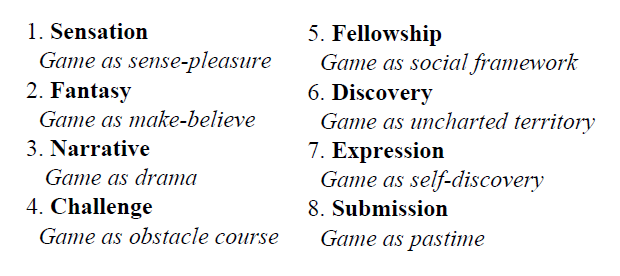
At its core, the MDA Framework is still a taxonomy, but its main premise is that games are emotional experiences. What the framework attempts is to classify the type of emotion a game can provide. In their paper, Hunicke, LeBlanc, and Zubek define eight classes (Aesthetics) that more or less can be used to define any game.

Each Aesthetic is a specific emotional expression, which they quickly define in a short table:

For example, consider the games Charades, Quake, The Sims and Final Fantasy. While each are “fun” in their own right, it is much more informative to consider the aesthetic components that create their respective player experiences.

Charades: Fellowship, Expression, Challenge

Quake: Challenge, Sensation, Competition, Fantasy

The Sims: Discovery, Fantasy, Expression, Narrative

Final Fantasy: Fantasy, Narrative, Expression, Discovery, Challenge, Submission

Hunicke, LeBlanc & Zubek, 2004

How to use the MDA

FIRST RULE: DO NOT MODIFY THE LIST!!!!

And of course, I have already broken the first rule. You see the problem is this: for them, Challenge is defined as either a physical or an intellectual challenge. I just can’t wrap my head around this. The way I see it, Challenge is a physical thing: fast reflexes, muscle memory, hand-eye coordination. The emotions I feel when I play a challenging game, like Mortal Kombat, are very different from what I feel when I’m playing a game that requires a lot of intellectual energy, like The Room. So I work with a list of 9 Aesthetics, the 9th being Puzzle: Game as a test for the intellect.

Okay, so… now…

FIRST RULE: DO NOT MODIFY THE NEW LIST!!!!!

Before inventing your own taxonomy, I believe that as a game designer, you should first understand the current one, and try to work within its limits. So, since the original list is not… detailed in its definitions, I’ll elaborate on what I understand are each of the aesthetics.

Sensation

Consider a game like Guitar Hero. This is a type of game that you experience through all your senses. You have to pay attention to the music, the flashy visual effects, fire explodes on each successful note, the music muffles and distorted noises appear on a mistake. While you’re playing you are on your feet, you are feeling the guitar in your hands, you slide your hand up and down the neck of the guitar to hit each fret, and before you know it, all your body is moving to the music.

A Sensation game is defined by the following features:

  • Emphasis on non-verbal information: The game transmits information through visual and sound effects. Text and numbers are sparse if any.
  • Strong use of VFX, SFX, and Haptic Feedback: The game attacks multiple senses at the same time. The experience is full and hectic.
  • Nondemanding fun: The player is happy, even if they lose a match. The game can be difficult to master, but even so, the experience is engaging.
  • Fast and Sustained: In a Sensation game the action runs at a very fast pace and for relatively long periods of time (in the order of tens of minutes, half an hour). But in a very physical game, this is limited to sessions of 5 or 10 minutes.

The fun in a Sensation game is to surrender your senses to the experience. The player disconnects from their environment and engages in a visceral, reactive way. Almost as if they are acting on instinct.

Examples of games that are Sensation First:

  • Guitar Hero: Sensation, Challenge, Submission
  • Beat Saber: Sensation, Challenge
  • Just Dance: Sensation, Challenge, Expression, Fellowship
  • DOOM (2016): Sensation, Challenge, Fantasy, Discovery

Fantasy

The world is in peril and the only hope is YOU!!!!

In a Fantasy game, the player assumes the role of a character in a fictional world. Fantasy games usually are larger than life, with hundreds of hours and tons of activities for the player to experience. The world is a playground for the player, filled with quests and things to do.

Key features of a Fantasy game are:

  • Role-Play: The player has an avatar in the game. This means the player IS the character. This goes hand in hand with the silent protagonist trope. The character is silent because they have no voice, no opinions, nothing to say about the world. The player is the one with a voice and an opinion. The character is just an empty shell for the player to inhabit.
  • Growth Mechanics: Experience points, Skill trees, Ability scores, and any mechanic that transmits the concept of getting better at stuff.
  • Big Stakes: In a Fantasy game the world, nay the Universe is always at stake. Epic adventures are common in this type of game. The player is the center of the universe.
  • The Hero: The player is the hero of the story. Usually in this type of game when a player relates their experiences, find themselves talking in first person: “I defeated the dragon” “I joined the faction A, and that made faction B my enemy”.

The fun in a Fantasy game comes from the make-believe. The player suspends their disbelief and becomes part of the fictional world.

Examples of Fantasy First games are:

  • The Legend of Zelda: Fantasy, Discovery, Challenge, Narrative
  • Fallout: Fantasy, Discovery, Puzzle, Narrative
  • Dungeons and Dragons: Fantasy, Fellowship, Narrative, Puzzle
  • Borderlands: Fantasy, Challenge, Fellowship (only if you play with friends), Narrative

Narrative

Lee crawled his way up to a fence, evading the zombies surrounding him. He climbed and entered a house. In it, he found a radio through which he met Clementine for the first time.

Narrative games have a written story, usually linear, that the player follows along. A narrative game favors decision-making and dialogue systems. Fantasy and Narrative usually come together, although it is possible to find a game that has the Narrative component and not the Fantasy one.

Narrative games are characterized by:

  • Complex tridimensional characters: The characters of a Narrative game have their own voice, their own opinions, and attitudes toward the world and the events unfolding. It’s not uncommon that the player might disagree with the character of a Narrative game.
  • The player as witness instead of protagonist: Since the characters in the game have their own voice, the player is a silent witness that accompanies and aids them through their adventure.
  • Small scale, big emotions: Narrative games can explore complex topics with more depth than Fantasy games. Through the moral and ethical lens of the characters in the story, different themes and events can be contrasted and discussed. Because of this depth, Narrative games tend to be smaller in scale. Not world-defining adventures, but adventures of huge importance to the characters involved.

The fun in the Narrative game comes from the drama. The player becomes engaged with the characters and wants to know what happens. In my humble opinion, the best narrative games are character-driven, not event-driven.

A few Narrative First games are:

  • Telltale’s The Walking Dead: Narrative
  • Life is Strange: Narrative, Puzzle
  • Final Fantasy VIII: Narrative, Puzzle, Discovery, Fantasy
  • Resident Evil 2 (Remake): Narrative, Discovery, Challenge
  • God of War (2018): Narrative, Fantasy, Challenge, Discovery (order may vary depending of the difficulty setting)

Challenge

GIT GUD!

What else do you need to know? Challenge games demand practice. A Challenge game requires fast reflexes, muscle memory, and hand-eye coordination. The Challenge game pulls no punches and has no patience, either you get good at the game, or do another thing.

Challenge games usually feature:

  • Player Centered Combat Systems: Systems that require the player to become skilled.
  • Easy to play, hard to master: Challenge games are usually simple, but tight. Responsive controls, precise animations, and predictable behaviors from both the Player Character and the obstacles or enemies around.
  • Fair and Unforgiving: Usually if a player loses a match, is their fault, not the game’s. A Challenge game is clear and fair, in the sense that every ounce of difficulty is on display. Random Number Generators and Dice Rolls are not welcome in this type of game.
  • Short Bursts and Good Pacing: Challenge games can be taxing for the player. So the Challenge game tends to engage the player in very short bursts of hectic action. No more than 5 minutes at a time with periods of rest. Challenge games usually are very well-paced.

The fun in the Challenge game comes from the cycle of tension and resolution. It’s a cathartic experience, during the highest tension sections the player is engaged, stressed, and in a state of pain (sometimes literal pain), once the tension drops, the player relaxes completely. This cycle works even if the player loses the match, but it’s way more satisfying if the player is successful, probably because of a huge discharge of endorphins and dopamine.

A few games with the Challenge First Aesthetic would be:

  • Mortal Kombat: Challenge, Fellowship, Sensation
  • Grand Turismo: Challenge, Fantasy
  • Super Meat Boy: Challenge, Submission
  • Cuphead: Challenge, Sensation, Fellowship (if you play with a friend)
  • Voxel Blast: Challenge, Sensation

Puzzle

This is the one I added to the list.

A puzzle game is a challenge for the intellect. In a puzzle game, you’ll find the player scratching their heads, retracing their steps, and questioning their life constantly. Usually, puzzle games are slow-paced, they let the player take their time to figure out what they need to do. Puzzle games can be classified into two groups: Puzzle Solving games present a sequence of puzzles linked by some sort of story or dramatic backdrop. Problem Solving games give the player a box of tools and a problem to solve. While a Puzzle has only one valid solution, a Problem has many and it’s possible to optimize. Both types engage the same abilities and provide the same type of fun, but their design is different. A Puzzle is designed backward, from the solved state to its unsolved state, a Problem is designed forward, creating specific challenges for the available tools.

Common characteristics of a Puzzle game are:

  • Puzzles (DUH!): Structures that require a specific order of operations to solve. Think of a puzzle box or an escape room.
  • Strategy and Tactical Systems: The player has to plan ahead, design a course of action and execute it efficiently.
  • Resource Management: Puzzle games require a lot of mental energy. This type of game is complex. The player has to handle many data points at once, a little mistake can snowball out of control or have unforeseen consequences.
  • Pattern Recognition and Lateral Thinking: Many times the correct solution is not the most obvious one. Pay close attention and think carefully. What do you know so far? What is different? What seems out of place?
  • Random Number Generators: Luck favors the prepared. Many tactical-oriented mechanics feature some sort of dice-throws.

The fun of the Puzzle game is similar to the Challenge game. The player engages in a problem that seizes their attention for periods of time. The difference is in the pacing, while the Challenge game has regular pacing with short bursts, in the Puzzle game the pacing is controlled by the player, and usually has longer bursts of lower intensity. The tension during a puzzle is not painful but could be described more as frustrating. Once the puzzle is solved the player feels intrinsically rewarded, it’s what we could call an “AHA! MOMENT”, which also (probably) hacks their dopamine pathways.

Examples of Puzzle First games:

  • SOOT: Puzzle, Narrative
  • The Room: Puzzle
  • SpaceChem: Puzzle
  • X-COM: Puzzle, Narrative
  • Starcraft: Puzzle, Narrative (if you play the campaign) or Fellowship (if you play against a friend)

You might’ve noticed that, at least the way I understand both aesthetics, Puzzle and Challenge are pretty much opposite to each other. Challenge is simple, Puzzle is complex. Challenge is transparent, Puzzle is obscure. Challenge is fair, Puzzle leaves much to chance. Challenge is fast, Puzzle takes its time. That’s why I could not wrap my head around the idea of Challenge being both the mental and the physical expressions of difficulty.

Fellowship

The game as a social framework. Fellowship games are built as systems of communication between players. The game acts as a moderator for the type, tone, and nature of the communication possible. Fellowship games don’t work unless you have multiple players interacting in the system. A Fellowship game can be competitive, cooperative, or both. The communication in the game can be verbal, physical, abstract, or concrete. Fellowship games can be classified in three groups: Party games have short sessions with silly mechanics and feature a lot of self-balancing techniques, Coop games have long sessions and are designed for in-person communication outside the game itself, and Competitive games take advantage of internet technology to provide a complex in-game non-personal communication structure.

Some common features of a Fellowship game are:

  • Multiplayer Only: The game only works if there are multiple players in the system.
  • The environment is inert: Usually, the game allows players to interact with each other, the environment (NPCs, maps, levels, etc…) is just a backdrop, not really interactive on its own. This is especially true for competitive games.
  • Unbalanced and Unrated: In a competitive environment, there’s little the designer can do to truly balance the game. Matchmaking techniques are limited and inherently flawed. The game can’t provide a truly balanced experience since the opposition is another human being. There are imperfect ways to rebalance during a match (Handicap and Rubberbanding).

The fun in a Fellowship game is anecdotical and complicit. It’s through the interactions between the players that the fun is provided. In a group of friends, people with a lot of mutual trust, the fun comes from the bonding and playfulness of the events during the game. The game can also become a tool to meet new people with common interests and engage in adventures.

Some Fellowship First games I can mention:

  • It Takes Two: Fellowship, Narrative, Puzzle, Challenge
  • Mario Party: Fellowship, Submission, Challenge
  • League of Legends: Fellowship, Puzzle
  • Nidhogg: Fellowship, Challenge, Submission
  • Hookbots: Fellowship, Challenge, Submission
  • World of Warcraft: Fellowship, Fantasy

Discovery

My personal favorite. In a Discovery game, the player is presented with a world of secrets and mysteries. The game is built on top of mechanics that allow the player to interact with the environment. Modulated by Puzzle, a Discovery game has the player constantly stopping in every corner, looking everywhere for things that pop. Discovery first games tend to allow the player to go anywhere they want.

A Discovery game usually has these features:

  • Non-Linear Structure: Space has two or three dimensions, sometimes four. In a Discovery game, the player is allowed to go around at their leisure. Open-World games are good examples of this property.
  • Guided Exploration: Discovery games have to deal with a delicate balance between freedom and aimlessness. Usually, the dramatic premise of the game helps guide the player, and Discovery games try to guide the player in a general direction. The player is free to ignore this guidance and go wherever, but the fact that there’s a “correct” path helps the player trace their own path.
  • Layered Exploration: As the player becomes acquainted with the world around them, the game provides them with new tools that allow them to move faster or reach new places. The game allows the player to push their boundaries and own the space around them.
  • Hidden Mechanics: The “space” can be a physical place or an abstract one. Discovery games usually feature secrets in their mechanics as well. Combos with certain items produce weird results, easter eggs hidden in the game and in the meta-space (achievements and collectibles for instance).

The fun of the Discovery game lies in the sense of exploration. Finding a new place, a hidden treasure, solving a mystery. In a way, it’s a very intimate experience with the space itself. These games work better in single-player experiences.

Examples of Discovery First games are:

  • Gone Home: Discovery, Narrative
  • Horizon Zero-Dawn: Discovery, Narrative, Challenge (order might vary depending on difficulty setting)
  • Metroid Zero Mission: Discovery, Challenge
  • Journey: Discovery, Sensation, Fellowship

Expression

While Discovery games struggle with aimlessness, Expression games embrace it. In this type of game, the player is presented with a toolbox but no problem to solve. Usually, the Expression game has a sandbox structure that allows the player to do whatever they want. The game acts as a creative outlet for the player. Expression games are more toys than games, untethered freedom is the goal.

Expression games can include some of these features:

  • Non-Enforcing Progression: Expression games can feature tracking systems with different goals for the player to engage with. But the game makes little to no effort in forcing the player to pursue these goals. Sometimes a small benefit can be attached to these small goals as a means to incentivize engagement.
  • Infinite Gameloops: The lack of a global goal means the game ends when the player stops playing. There’s no end-game in an Expression game.
  • Chaotic Synergies: When designing several mechanics in a system, the game designer usually tries to contain and direct synergies, but in an Expression game it’s common that whatever unexpected behavior found in the game dynamics is left unhindered. The result is usually chaotic and ridiculous, which are the most desirable characteristics of a viral meme.

The fun in an Expression game is silly by nature, innocent and free. Most Expression games allow situations that resemble those of Free Play. The player decides which level of engagement they want from the game, and it can range from simple fun to the most complex and elaborated self-imposed challenges. The trick is: the game is not pressuring the player in any direction.

Examples of Expression First games are:

  • Minecraft: Expression, Discovery, Challenge
  • Cities Skylines: Expression, Puzzle
  • The Sims: Expression, Submission
  • Goat Simulator: Expression, Sensation, Submission

Submission

This is the game you play on the bus, on the toilet, a quick session before sleep. Most commonly found in mobile devices, a good Submission game doesn’t expect anything from the player. Simple experiences, infinitely replayable, with irrelevant progression or no progression at all. The submission game is something to switch the brain off for a few minutes, something to kill boredom in between tasks.

A good Submission game has the following characteristics:

  • Non-Demanding: There is no such thing as “getting good” at Candy Crush… A good submission game can be learned quickly and there is nothing to master.
  • Shortest or Longest Sessions: A good Submission game can be played for a few minutes or a few hours at a time. Its simple structure allows the player to engage for long periods of time, but the player can disengage at any moment.
  • Infinite Replayability: Submission games lack drama, and thus you can replay them again and again without spoiling the experience in any way. Tetris’ 1000th playthrough is as fun as the first.
  • Deceptively Simple: Submission games usually masquerade as other types, typically Puzzle games. Match 3 mechanics require pattern recognition abilities, but the level of complexity of Bejeweled is in no way compared to something like a Missing Object game. The secret sauce lies in the game’s difficulty: Submission games don’t have any.

The fun of the Submission game comes from its simplicity. It’s just a distraction, nothing more.

Good examples of Submission First games are:

  • Bejeweled: Submission, Puzzle
  • Plants vs Zombies: Submission, Puzzle
  • Tetris: Submission, Puzzle
  • Temple Run: Submission, Challenge
  • CANABALT: Submission, Challenge
  • My Name is Mayo: Submission, Narrative

A GOOD Submission game doesn’t demand anything from the player. But Submission games have a peculiar property: they are extremely effective at hijacking the dopamine pathway. This means Submission games tend to be addictive more easily than any other type of game. Add the fact that Submission games are very easy to develop, and the result is a market section that specializes in addictive games. This doesn’t mean every Submission game is dangerous or ill-intentioned. Tetris is as good today as it was in 1985. But from an ethical standpoint, I think it’s important to acknowledge this Aesthetic is linked to one of our biggest issues in today’s game industry.

Closing Remarks

Consider this document an essay, by that I mean this review of the Aesthetics has a lot of my own personal perspectives and opinions weaved in between the lines. Some of them are evident, some are not so much. So take everything I say with a grain of salt.

That said, understanding each Aesthetic has helped me become a better game designer, and this analysis is my main tool when I teach game design, to which I can report pretty satisfying results.

This is only the first level of design, I hope to complement this article with some insight on how to provide Aesthetics through mechanics (Mechanic Alignment) and how to handle multiple Aesthetics in one game (Subordinate Aesthetics). There’s a method to my madness, maybe if I leave it in writing this might be helpful for someone in the future.

And if you are Greg Costikyan, Marc LeBlanc, Staffan Björk, Jenova Chen, or any other of the authors I mention here, and you happen to hate everything I said… please don’t tell me :D.

BYEEEEEE!